Fortunes Below Dev Diary 2: Outline and Scope
Welcome back to a dev diary for Fortunes Below! Today I wanted to talk about developing the outline for this adventure and defining scope early on in the process.
Last time, I spoke about my process of the "preproduction." In my post mortem for the Violet Heart, I discovered a better workflow for writing and creating adventures. The last dev diary essentially boiled down all the things I realized this adventure was going to be because of the work I did in the brainstorming process.
When I was going through my outline process, I took all my ideas in my brainstorming process and began to distill them, throwing out certain things, fleshing out other things, and most importantly, putting them in order, until I got to a certain point that I felt comfortable. At that point, roughly two weeks ago at the time of writing this, I started the manuscript for real.
But let's go back to the outline. Fortunes Below is going to be made up of three acts. Let's talk about what each one contains and why I structured them this way.
The three act structure is the story structure I am the most familiar and comfortable with. It is the most common formula for movie scripts, and once you understand how it works, you can't go back to viewing movies without seeing the three act structure every time you sit down to watch one. Five acts are common for hour long television shows, but that's not the reason I chose it for the Violet Heart. I chose it because I was using the Dark Heart of the Wood for my structure guide for a Draw Steel quest, and that was broken up into 5 acts.
When I was brainstorming Fortunes Below and expanding it from a quest into a full adventure, I took a look at the Fall of Blackbottom, which contains a more familiar three act structure. As a very quick run down of a three act structure if you're not familiar, Act 1 contains the inciting incident and introduction to the threat and how that interacts with the protagonists' goals, Act 2 contains the various obstacles the protagonists face on their way to confrontation with major opposition, and Act 3 contains the resolution of their struggle. In Fall, Act 1 begins with Blackbottom attacked and attempting to get to safety, Act 2 contains following leads to secure a safe route out of the city, and Act 3 is the escape sequence, which contains different encounters depending on the actions taken in Act 2.
I think understanding story structure is vital for creating RPG adventures, especially ones for Draw Steel or other cinematic RPGs. There is a whole argument to be made in the OSR space that the "story" that comes out of an RPG adventure is from the actions that the characters take in a sandbox, and while I think that's interesting, it's not the style of adventures that Draw Steel has. They are more about a series of encounters that will have a specific flow. There is still, of course, room for player ingenuity because at the end of the day this is an RPG and you don't want to railroad your players.
Some people really have a problem with linear adventures, but I enjoy linear adventures quite a bit. There is a difference between RAILROADING and being ON RAILS. Railroading is forcing players to do what you decided in your adventure prep. An adventure on rails just means that at each reversal, reveal, or climactic moment, the protagonists have a generally reliable idea of where to go next. A then B then C. My Curse of Strahd campaign is wrapping up soon, and I discovered earlier in the campaign my group was sort of having a hard time with some aspects of that sandbox adventure structure - the idea that you could go anywhere and get in over your head. In my prep, I had an idea of which adventure locations were appropriate for what level, and my players were constantly trying to do more research and ask NPCs about which they should tackle next based on their current capabilities. This made me realize that, at least sometimes, RPG players WANT to have a clear order of things – a linear adventure.
In quests like the Dark Heart of the Wood and the Violet Heart, there are encounters you will face in a specific order. How you interface with those encounters is completely up to you. Another reason why I enjoy linear adventures like a DS quest is that they are SHORT and have a limited scope. In the Fall of Blackbottom, Act 1 was linear, then Act 2 was made up of a bunch of encounters you could tackle in any order, and then Act 3 is made up of a series of encounters based on which approach you took in Act 2. This structure is almost completely the same in the Delian Tomb too. This was absolutely brilliant and the structure I wanted to steal for Fortunes Below. I think if you were to do a COMPLETELY linear structure in an adventure with a full level's worth of content in it, that would get exhausting. Allowing for player choice of where to go and when during Act 2, and then having those choices pay off during Act 3 is brilliant design.
Here's the general story structure of Fortunes Below: In Act 1, the heroes arrive in town during the harvest festival where it is interrupted by an earthquake which releases elementals from below the earth. The heroes must fight the elementals, then discover where they came from: an ancient tomb underneath the town, locked behind a door. This is the reversal that leads us into Act 2. Townsfolk will approach the heroes and tell them about all the weird stuff that's happening in the local area. The heroes can investigate all these areas, fighting monsters and local troublemakers. Along the way, the heroes can learn that all these threats are directly tied to a group of treasure hunters attempting to bypass magical seals and get into the tomb beneath the town. They must unlock the tomb, but all the while the villain's plans are still underway, represented by a countdown. Act 3 starts either when the heroes get their key and go into the tomb, or the countdown runs out and the town is under major threat.
So, Act 1 is a linear series of encounters to get the heroes up to speed with what's going on in town. Act 2 provides different locations the heroes can visit and they'll face enemies, gain Victories, treasures, and the plot coupons to get into Act 3. Currently, I'm thinking they only need to clear out 2 of the 5 locations to get into Act 3 (two halves a broken key or something like that) BUT the heroes are incentivized to keep exploring during Act 2 because of the rewards they continue to get. BUT they can't spend too long exploring because every encounter and every respite they take during this Act will tick down the countdown or else some really bad stuff happens if the countdown resolves. Of course, the heroes can still save the day, but it will be harder.
There is no right or wrong way to build an outline! The outline only needs to make sense to the people who are writing the adventure. Here's a couple of examples from my outline. The ideas in here are obviously subject to change.
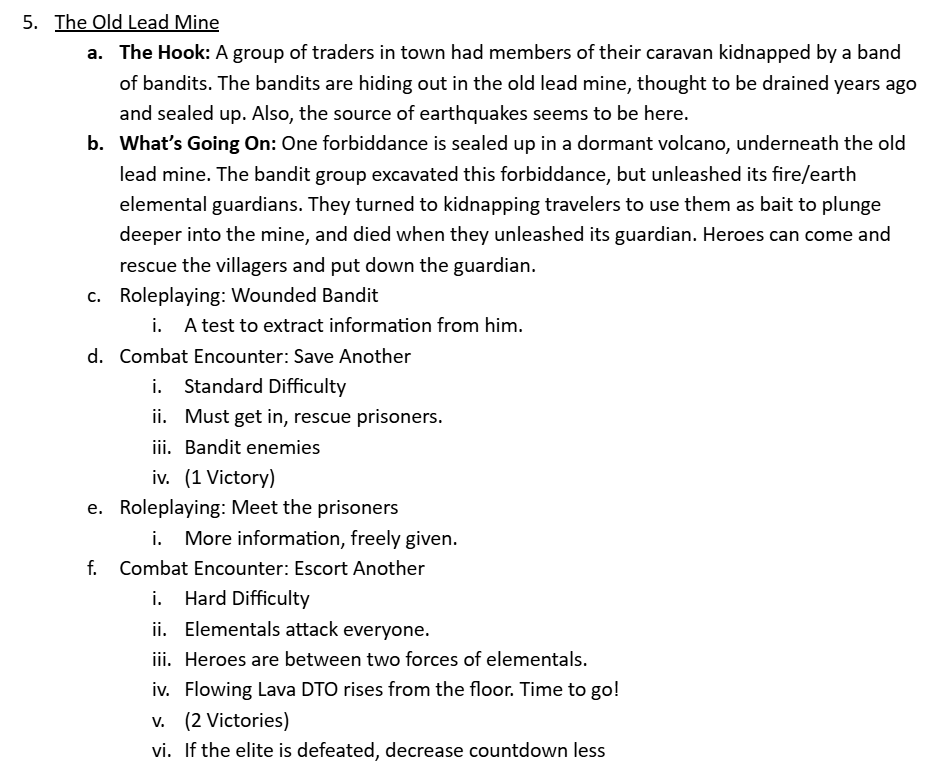
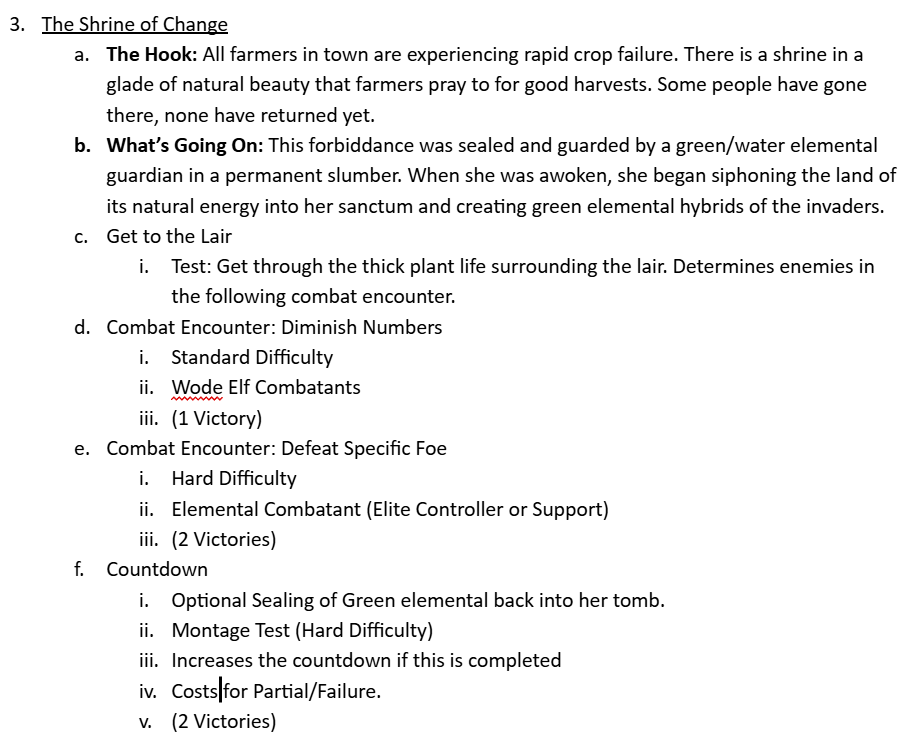
These are two adventure sites from Act 2. In the outline, I needed to know what hooks the heroes into investigating, what's actually going on that they can find out when they arrive and explore, and the encounters within. The encounters note the objective, how hard they will be and how many Victories they will reward, and what combatants and dynamic terrain they will face. I also have a couple ideas for rewards at each of these places and the consequences for success and failure in these locations.
I haven't defined every little thing in my outline, I'm getting just enough so I have a structure for the actual manuscript writing while leaving room for creativity. Your outlines may have a lot more things defined in it, and this might look like brainstorming to you.
Scope Creep and Discipline
Another thing I note in my outline was what kind of new things am I going to have to design, not including unique versions of encounters, montage tests, and negotiations. Things that aren't in the core rules and are totally unique to this adventure: systems, treasures, monsters. I needed to get a sense of how big this adventure was going to be. The combat encounters became more fleshed out and interesting. However, I became aware of the creeping scope when I began thinking about monsters in this adventure. I wrote in my previous post that a lot of my adventure ideas come from reading interesting entries of monster lore. I like working in the space that the monster designers gave me, where I get a statblock and lore and I make the narrative around that.
However, I wanted more elementals than the ones found in Draw Steel: Monsters. A lot more. My idea for each of these adventure sites had some combination of two elemental essences guarding it. For example, in the Old Lead Mine, I wanted earth and fire elementals. For the Shrine of Change, water and green. For the Coal Mine, air and rot. For the Mallory Farm, rot and void. And for the Goblin Refinery, water and air. I wanted an elite that would be the primary guardian along with some platoon, horde, or minion creature to reinforce them.
But each adventure site would essentially have its own mini monster band, and now the scope became really bloated. So I had to go back to the drawing board and looked at how many new monster stat blocks are included in each of MCDM's other adventures. There's roughly 10. I began a checklist: 5 unique rivals as the band of treasure seekers (elites), 1 unique fossil cryptic (solo), and 5 unique elementals for each adventure site (elites). That's already eleven. Doable because all of them would essentially be unique modifications of already existing statblocks. I would take a look at the Gilded Hand in the Delian Tomb for how to make unique rivals, take a look at Yddraed in the Dark Heart of the Wood and how they differ from a standard thorn dragon, and take a look at the dastards in Draw Steel: Encounters for inspiration on the unique elementals. So what was I going to do about the lesser elemental creatures I wanted to reinforce the big guys?
I was reading through Draw Steel: Monsters about customizing monsters and came across this bit on reskinning monsters:
"stat blocks aren’t intended to be modified or adjusted (with the exception of animals and rivals, as noted above). Your best bet for adjusting any given monster is to find another monster of the level, organization, and role you’re looking for, and reskinning that monster while using their statistics." Draw Steel Monsters pp. 26.
Well, if the designers were advocating for that, why not? I have no idea how people might respond to reskinning monsters in a published adventure, but I'm willing to try it. If it falls flat on its face, lessons learned! So my plan is to rename the creatures I will be using to more elemental appropriate names while including the original statblock name in the encounter groups list, and in the appendix include a short description for how the elemental looks. I won't have art for all these little guys, so words will have to do.
I had to decide which monster band to proxy for which combination of elements worked best. This is what I came up with: For the Goblin Refinery, I wanted creatures that would evoke storm themes of water and air, and decided to use Angulotls. For the Mallory Farm, I wanted creatures that would evoke the weird and destructive themes of rot and void, and decided to use Demons. For the Coal Mine, I wanted creatures that would evoke the tomb dust theme of rot and air, and decided to use Undead. For the Old Lead Mine, I wanted creatures that would evoke a molten rock theme of earth and fire, and decided to use Kobolds. And finally for the Shrine of Change, I wanted to evoke the themes of unending growth of green and water, and decided to use Wode Elves and High Elves.
My current thinking is that all of these creatures, despite coming from different monster bands, will have access to elemental traits and Malice.
I can absolutely see a world in which I create a supplement overhauling elementals and you can add traits to them like in the Rivals and Animals section of DS: Monsters. But that's out of the scope of writing this adventure.
Time and testing will show if this was a good idea or not. I may just scrap the whole idea and switch back to using the standard elementals in the Monster book. We'll see!
The lesson here is learning the discipline required to not go and make a bunch of new statblocks. The scope would grow out of control and though this is a more ambitious project than my previous one, I did not want to create a whole new Monster book in order to write it.
Hopefully this was interesting. Next time we'll probably talk more specifics about the narrative and get some previews of Act 1.
Until next time!
Member discussion